
The short answer
SEO for a contractor is about showing up for the searches that turn into jobs, in the towns you actually want to work in. Most of it is plain work done steadily:
- Know your three kinds of searches: a service plus a town, an emergency right now, and a homeowner researching a big project.
- Give each one a page: a page per service, pages for the towns you really serve, and guides that answer cost and timeline questions.
- Finish your Google Business Profile, because for most local searches the map shows before any website.
- Collect reviews every week and post real job photos, because in a busy market that's what separates you from everyone else who did the basics.
- Make the site fast on a phone, because that's where most of these searches happen.
- Expect months, not weeks, especially in the busier suburbs.
If you're still deciding what the site itself should have, our guide to contractor website must-haves covers the features. This one is about search: what people type, and how you get in front of them.
The three searches that bring contractors work
Homeowners don't search for "contractor". They search for the job, and the way they search depends on how urgent it is.
1. Service plus town
The everyday search: "siding contractor Monticello", "basement finishing Plymouth". The person knows what they want and is choosing who to call. These searches decide most of a contractor's inbound work, and they're won by a clear page for each service and good coverage of the towns you serve.
2. Emergency, right now
Home services live on these: "emergency plumber", "no heat", "water in basement", "tree fell on house". The searcher is on a phone, often at night, and will call the first credible result. Your Google profile matters most here (open hours, the emergency service listed, reviews), followed by a fast page with a phone number they can tap without scrolling.
3. Project research
Remodelers, builders and exterior contractors get a third kind: "how much does a basement finish cost in Minnesota", "how long does a kitchen remodel take", "do I need a permit for a deck". These people aren't ready to call yet. They're weeks or months away. The contractor whose guide answered their question honestly is often the one they call when they're ready.
Here's how the searches line up with the pages that win them:
| Kind of search | What people type | Who searches like this | The page that wins it |
|---|---|---|---|
| Service plus town | "deck builder Maple Grove", "water heater install Buffalo MN" | Every trade. The bread and butter. | A page per service, plus town pages (and city and service pages for your top work) |
| Emergency, right now | "emergency plumber", "furnace not working", "water in basement", "roof leak repair" | Plumbing, HVAC, electrical, restoration, roofing, garage doors, locksmiths | Your Google profile first, then a fast emergency service page with a tap-to-call number |
| Project research | "how much does a bathroom remodel cost", "how long does a kitchen remodel take", "vinyl vs fiber cement siding" | Remodelers, builders, exterior contractors, landscapers | Guides that answer the question honestly, linking to the service page |
| Near me | "roofer near me", "electrician near me" | Everyone, on phones | Your Google profile, with a real address or service area. The words "near me" don't need to be on your page |
| Your name | "[your company] reviews", "[your company] phone" | People who heard about you | Your home page and profile, with consistent name, phone and reviews |
Examples are illustrations, not measured search volumes. Your own Search Console shows which of these you already appear for.
Service pages: one job, one page
A common gap on contractor sites is one "Services" page listing everything. Google can't tell which job that page is about, and neither can the homeowner. Give every main service its own page.
For search, a good service page has:
- The service and your main area in the title and heading, the way people search it: "Roof Replacement in Buffalo and Wright County", not "Our Roofing Solutions".
- What the job actually involves, in plain words: what you do first, what materials you use, how long it takes.
- What affects the price, or a range if you can give one. Price is the question every homeowner has.
- Real photos of that service, with captions that say what and where.
- Questions and answers people ask on the phone, written out.
- Links to the town pages where you do that work, and to any guide on the subject.
Split services the way customers do. "Plumbing" is one page for a handyman; for a plumber it's water heaters, drain cleaning, repiping, sump pumps and fixtures, each with a page. A remodeler might have kitchens, bathrooms, basements, additions and whole-home. Check your pages with our free on-page SEO checker.
Town pages and city and service pages
Once each service has a page, cover the towns. A town page that's genuinely about your work there (projects, the kind of homes, scheduling, local permits) helps you show up in the ordinary results for that town, including towns too far away for the map to show you.
For your top two or three services in your main towns, go one level deeper with a page per service per town: "bathroom remodeling in Plymouth". MDR, a design-build remodeler we built for in Farmington, has eighteen city pages and fifty-four city and service pages across five service lines, each built around the place and the work. That's a big site for a contractor with a lot of work to show. Most should start smaller.
The trap is copy-paste pages with the town name swapped. They don't help and can hurt. Our guide to service-area pages done right covers how many to build and what goes on each one, and small-town vs metro local SEO explains why a page that's enough in Montrose won't be in Maple Grove.
Your Google Business Profile
For most local searches, the map comes first, and the map is your Google Business Profile. Google says local results are mainly based on relevance, distance and prominence (Google's local ranking help page, checked November 2026). For a contractor, that means:
- The right primary category. The one that describes your core business: "Roofing contractor", "Plumber", "Kitchen remodeler". Google's guidelines ask for the fewest categories that describe the core business, so add secondary ones only for real work you do.
- Services listed one by one, in the same words as your service pages.
- A real service area. Most contractors work at customers' homes, so set the towns you actually cover. If customers don't come to your shop, you can hide the address and show the service area instead.
- Hours that are true, including emergency hours if you take emergency calls, and holiday hours.
- Photos of real jobs, added every month or so, not just a logo and a truck.
- Your business name exactly as it is, with no towns or keywords added.
Our guide to Google Business Profile for service businesses goes through every field and the mistakes that get profiles suspended.
Reviews: the part you can't skip
Google says prominence draws on things like how many reviews you have and how many websites link to you, and that more reviews and positive ratings can help. In a busy suburb where every competitor has a decent profile, reviews are often what decides who shows up first.
What works for contractors:
- Ask at the right moment. When the job is done and the customer is happy, often at the walk-through. Not three weeks later on an invoice.
- Make it one tap. Text them your direct review link. Our free review link generator gives you one.
- Ask every customer, every week. Steady beats a one-time push. A profile that gets new reviews all year looks, and is, more active.
- Reply to every review, good and bad. Short, specific, polite. A calm reply to a bad review reassures the next reader more than the review worries them.
- Let customers say what and where. Don't script them, but a review that mentions "our basement in Rogers" is more useful to the next reader than "great job".
Then show them on your site, on the service and town pages they're about. Our guide to reviews on your website covers how to do that without breaking Google's rules.
Photos of real jobs
Real job photos do three jobs at once. They prove you do the work. They give your service and town pages something specific to say. And on your Google profile, Google lists adding photos among its tips for local ranking.
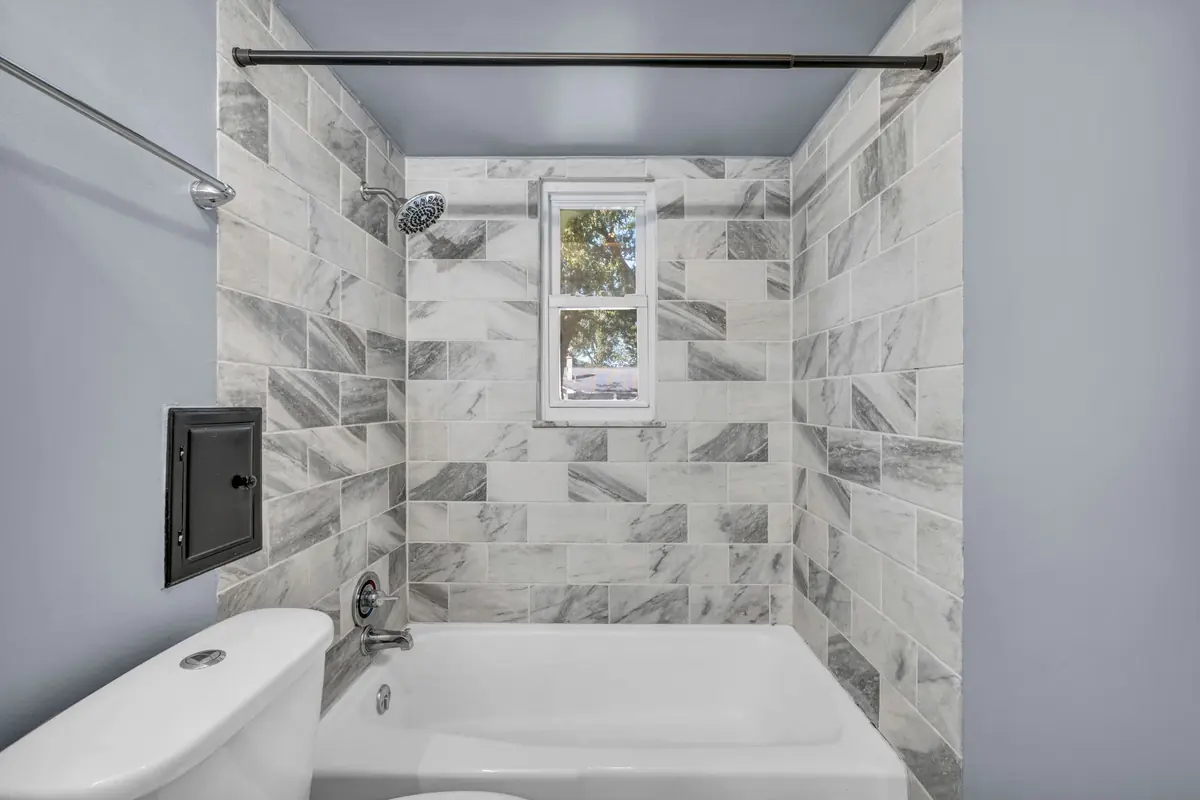
For search, a photo works harder when:
- It has a plain file name: bathroom-remodel-plymouth-tile-shower.jpg, not IMG_4471.jpg.
- It has alt text describing what's in it, for people using screen readers and for Google. Check yours with the free image alt text checker.
- It has a caption with the job and the town: "Walk-in tile shower, Plymouth".
- It's sized for the web, so it doesn't slow the page down on a phone.
- It sits on the page about that service or town, not only in a gallery nobody links to.
Take before, during and after shots on every job, even when you're not sure you'll use them. Get the customer's OK to post photos of their home, and leave out house numbers and faces.
Guides that answer cost and timeline questions
For contractors who sell big projects, guides are the most underused part of SEO. A homeowner planning a remodel spends weeks reading before they pick up the phone. If your page answered "how much" and "how long" honestly, you're already on their list.
The guides worth writing are the questions you answer on every estimate:
- What does a [your project] cost in our area, and what pushes it up or down?
- How long does it take, from first call to finished, and what causes delays?
- Do I need a permit, and who pulls it?
- Which material or option should I choose, and why?
- What should I ask a contractor before I sign?
MDR's site has a ten-guide library built this way, written around the questions their customers ask before a remodel. Each guide links to the matching service page, so a reader who's ready can move straight to it. You don't need ten to start. Two honest guides on your biggest jobs beat a blog of short posts nobody reads.
Write them in your own voice, with your own numbers and examples. Give price ranges and say what drives them. A guide that dodges the price question doesn't earn the reader's trust, or Google's.
Speed on a phone
Most of these searches happen on a phone, often on a job site or in a driveway, and often on a weak signal. A page that takes a long time to show anything loses the caller to the next result.
Google measures real-world experience with Core Web Vitals, one of the many signals it uses. A page passes when, for at least three in four visits, the main content shows within 2.5 seconds (LCP), the page responds to a tap within 200 milliseconds (INP), and the layout doesn't jump around (CLS of 0.1 or less). Mobile and desktop are measured separately (web.dev, checked November 2026).
Contractor sites often fail on huge uncompressed job photos, heavy sliders, and too many add-ons loading at once. Run your key pages through our free website speed test, and see our guide to page speed and Core Web Vitals for the fixes. Every site we build is custom-coded and served from Cloudflare's edge, so speed is built in rather than added later.
What to expect over the first year
SEO for a contractor isn't a launch, it's a habit. Here's a realistic picture for a business starting with a weak site:
| When | What's happening | What you should see |
|---|---|---|
| Weeks 1 to 4 | Profile completed, service pages live, site fast on a phone, old pages redirected | Google re-crawling the site. Possibly more profile views. Little change in calls yet |
| Months 2 to 3 | Reviews coming in every week, first town pages and guides live | Showing up for your trade plus your home town, and for your name. Search Console shows more searches |
| Months 4 to 6 | More project write-ups, a few real local links, more guides | Map pack more often near your shop. Some research guides start bringing visitors |
| Months 6 to 12 | Steady: reviews, new jobs written up, pages kept current | Calls from towns further out, through ordinary results. Small towns often settled; busy suburbs still climbing |
A typical pattern for a contractor starting with a weak site, not a promise. Small towns usually move faster than busy suburbs, and every market is different.
If you need calls before the SEO kicks in, or you work in storm-driven or seasonal trades, ads can fill the gap. Our guide to Google Ads vs SEO shows when each makes sense.
A worked example
Worked example
A made-up HVAC company based in Elk River does most of its work in Elk River, Otsego and Big Lake, wants more replacement jobs, and gets a lot of no-heat calls every winter.
Emergency searches: the Google profile lists 24-hour emergency service with true hours, "HVAC contractor" as the primary category, and furnace repair, AC repair and replacement as services. The emergency repair page loads fast and shows a tap-to-call number at the top.
Service plus town: separate pages for furnace repair, furnace replacement, AC repair, AC replacement and maintenance plans. Town pages for Elk River, Otsego and Big Lake, each with real installs in that town. City and service pages for furnace replacement in Elk River and Otsego, the two biggest earners.
Research: two guides. What a new furnace costs in central Minnesota and what changes the price, and repair or replace (how to decide). Both link to the replacement page.
Every week: a review request by text after each job, and a few photos of each install added to the profile and the matching page.
None of this is clever. It's done in the right order and kept up, which is what most competitors don't do.
If you're in Wright or Sherburne County, see our pages for Elk River and Otsego for how we work locally.
What to avoid
Most contractor SEO trouble comes from shortcuts. Skip these:
- Buying links or joining link schemes. Google's guidelines prohibit it, and the links that come cheap are the ones that hurt.
- Fake or paid reviews, or reviews written by staff. Against Google's rules, and customers spot them.
- Keyword stuffing: "Buffalo roofer, roofing Buffalo, Buffalo MN roofing company" in every paragraph. Write it once, naturally.
- Keywords in your business name on your Google profile. Google's guidelines say the name must match your real-world name, and adding extra words can get the profile suspended.
- Copy-paste town pages with the town name swapped. See service-area pages done right.
- Fake addresses or mailbox offices in towns you want to rank in. One profile per business, at a real location or with a service area.
- Anyone who guarantees rankings. Google says there's no way to pay for a better local ranking. Nobody can promise one.
If you hire help, ask exactly what they'll do each month, what you'll see in reports, and who owns the pages and the profile. National contractor marketing agencies usually sell SEO inside a monthly program with ads and reporting, and quote it rather than publish a price, so also ask how long the contract runs. A program built for a busy metro market is more than a small-town contractor usually needs.
Where we fit
We build fast, custom-coded sites for contractors and home-service businesses, with the structure this guide describes: a page per service, real town pages, job galleries and room for guides. Every build includes on-page SEO foundations and Google Business Profile setup, and ongoing content and link work can be scoped on top. See our local SEO work, or the pages for remodelers and roofers.
If you'd rather do the SEO yourself, this guide is the plan. Start with the service pages and the profile, ask for a review after every job, and add one honest guide a month.
Want a straight answer for your business?
Every Stonekept build is custom-coded, hosted on Cloudflare and kept on a monthly plan. Prices are public: builds from $2,200 with care from $199/mo. See pricing or tell us about your project and we'll give you an honest read, even if that's not us.